Every February, a lot of Minnesota homeowners end up on a ladder with a roof rake, a hammer, or a hose of hot water, fighting a ridge of ice at the edge of their roof.
That fight is worth having when water is coming through the ceiling. But it is a symptom fight. The ice at your roof edge is the last step in a chain that starts inside your house, and you cannot solve it from the outside.
Here is the actual cause chain and what actually fixes it. August is the right month to read this, because the fix involves work nobody wants to schedule in January.
The Cause Chain, Start to Finish
Ice dams are not caused by cold weather. They are caused by an uneven roof temperature, which is a very different problem.
Step one: heat escapes into your attic. Warm air from your living space leaks upward through ceiling penetrations, gaps around light fixtures, bath fans, attic hatches, plumbing stacks, and top plates. Insufficient insulation lets more of it through.
Step two: that heat warms the roof deck. The upper portion of your roof, sitting over the heated attic space, rises above freezing.
Step three: snow on the warm section melts. Not from sun. From below.
Step four: the meltwater runs down and hits the eaves. The eaves overhang the exterior wall, so there is no heated space below them. They stay at outdoor temperature.
Step five: it refreezes at the cold edge. Layer on layer, over days and weeks, until there is a solid dam of ice sitting on the eave.
Step six: water backs up behind the dam. Now you have standing water on your roof, and asphalt shingles are designed to shed running water, not to hold standing water. It works its way under the shingles, through the deck, and into your soffits, walls, and ceilings.
That is the whole mechanism. Every effective fix interrupts it at step one or step two.
What Actually Fixes Ice Dams
Air sealing the attic floor. The highest-value fix and the one most often skipped. Sealing the gaps where warm air enters the attic stops the problem at the source. Recessed lights, bath fan housings, the attic hatch, chimney chases, and wire and pipe penetrations are the usual culprits. Insulation alone does not stop air movement, which is why adding insulation without air sealing often changes nothing.
Adequate insulation, correctly installed. Depth matters, but so does being continuous, uncompressed, and not blocking the soffit vents at the eaves. Baffles keep that airway open.
Balanced ventilation. The goal is a cold attic that matches outdoor temperature, which takes intake at the soffits and exhaust at the ridge, roughly balanced. A ridge vent with blocked or nonexistent soffit intake does very little, and this is an extremely common defect in Minnesota homes.
Ice and water shield at the eaves. A membrane installed under the shingles during a roof replacement. It does not prevent ice dams. It prevents the water backing up behind one from entering your house. How far it extends up from the eave matters, and it is a line item to look for on any roofing quote.
Notice what is not on this list: heat cables, roof raking, and chipping. Those are symptom management. A house that needs a heat cable every winter has an attic problem nobody has fixed.
What to Do If You Have One Right Now
Because sometimes you are reading this in January with a stain spreading across the ceiling.
Do not chip at it. A hammer, chisel, or hatchet on a roof edge damages shingles, gutters, and flashing, and creates next year’s leak while solving this year’s.
Do not use a torch or an open flame. People do. It ends badly.
A roof rake works for clearing snow from the first three or four feet of roof edge from the ground, which removes the material the dam feeds on. Stay off ladders on ice. Watch for power service lines.
Steam removal is the professional answer. Low-pressure steam melts the ice without damaging the roof. It costs money and it is worth it compared to a hatchet. Insist on steam, not pressure washing, and not hot water blasting.
Deal with the interior water. Move belongings, contain the drip, and photograph everything. If it becomes an insurance question, contemporaneous photos matter. Coverage for ice dam damage varies substantially by policy, so read yours and call your carrier rather than assuming either way. The Minnesota Department of Commerce has consumer guidance on homeowner claims.
Gutters Are Not the Problem, But They Do Get Wrecked
A persistent myth is that ice dams are caused by clogged gutters. They are not. An ice dam forms on the roof edge whether or not a gutter is there at all. Homes with no gutters get ice dams.
That said, gutters make things worse and take the damage. A gutter full of leaves fills with ice, adds weight, and gives the dam a foundation to build on. Ice expansion pulls gutters loose from the fascia, bends hangers, and cracks seams. Every spring in Minnesota, a share of the gutter replacement work happening is ice dam damage from the previous winter.
So clean your gutters in the fall. Not because it prevents ice dams, but because it prevents a worse version of them and saves the gutters.
Signs Your Attic Is Set Up for Trouble
Worth checking now, in August, while your attic is accessible and you are not desperate:
- You can see daylight around a bath fan, chimney chase, or light fixture from inside the attic
- Insulation is thin, uneven, or has been pushed aside near the eaves
- Soffit vents are blocked by insulation with no baffles installed
- There is a ridge vent but no visible soffit intake, or vice versa
- Frost or moisture on the underside of the roof deck in winter
- Rusty nail tips protruding through the deck
- Your bath fan or dryer vents into the attic rather than outside
That last one is more common than it should be and it is a straightforward fix.
If several of these are true, you have an air sealing and ventilation project, not an ice problem. It is also work that reduces your heating bill, which is a nice side effect. If you are already thinking about energy costs, we have written about lowering energy bills more broadly.
Where This Intersects With Your Roof and With Solar
If you are replacing your roof anyway, that is the moment to get ice and water shield coverage right, correct the ventilation, and install proper baffles. All of it is dramatically cheaper as part of a replacement than as a separate project. Our guide to roof replacement cost in Minnesota covers where those line items appear on a quote.
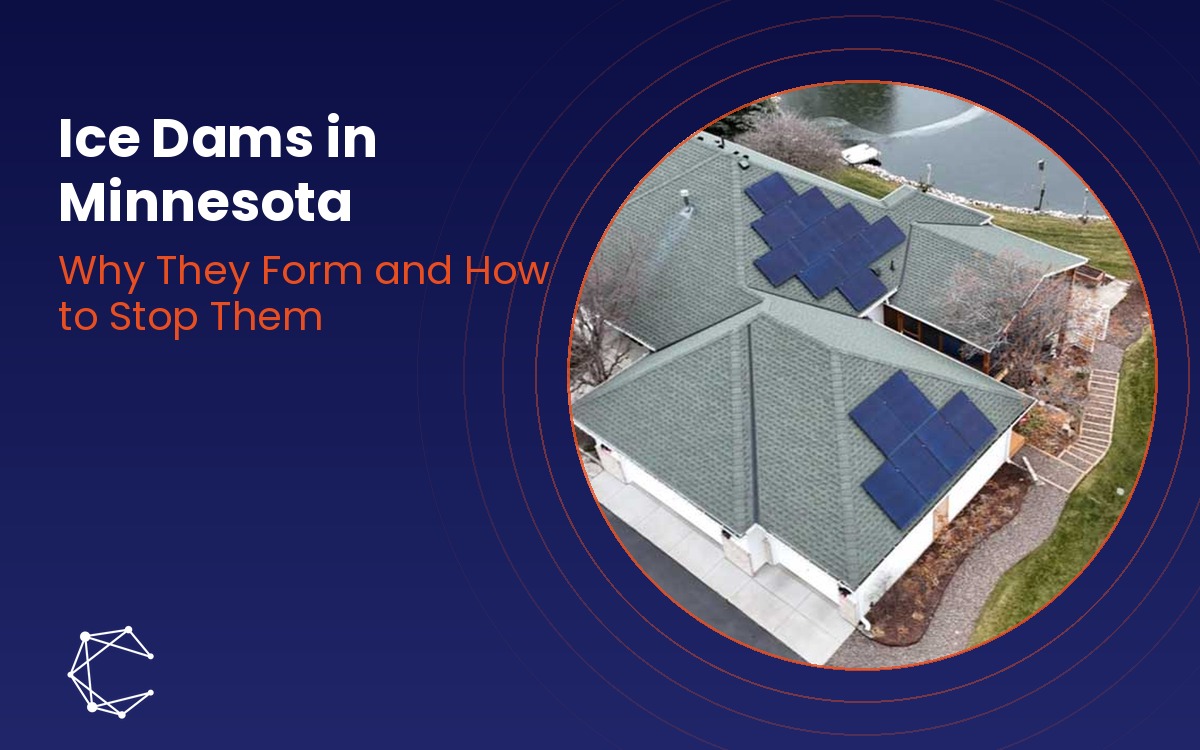
If you have or want solar, attic ventilation drives shingle lifespan. A poorly ventilated roof ages faster, and a roof that fails early under an array means paying to remove and reinstall panels. Getting the attic right protects both. Roof replacement before solar walks through that math, and metal roofs shed snow well enough to change the ice dam picture entirely, covered in metal roofing vs. asphalt shingles.
For technical guidance on attic ventilation and moisture control in cold climates, the U.S. Department of Energy publishes homeowner-level material worth reading.
Frequently Asked Questions
What causes ice dams in Minnesota?
Heat escaping from your living space into the attic warms the upper roof deck, melting snow that then runs down to the cold, unheated eaves and refreezes. The resulting ice ridge traps standing water on the roof, which works under the shingles. The cause is uneven roof temperature, not cold weather.
How do I prevent ice dams permanently?
Air seal the attic floor to stop warm air from leaking up, add adequate uncompressed insulation, and establish balanced ventilation with open soffit intake and ridge exhaust. Ice and water shield installed during a roof replacement protects the house if a dam still forms.
Do heat cables fix ice dams?
No. Heat cables melt a channel through the ice so water can escape, which manages the symptom. They do not address the heat loss and ventilation problem causing the dam, and they add operating cost every winter.
Are ice dams covered by homeowners insurance?
It depends entirely on your policy. Sudden interior water damage is more commonly covered than gradual damage or the cost of removing the ice itself, but terms vary significantly. Read your policy and call your carrier rather than assuming, and document everything with photos.
Do clogged gutters cause ice dams?
No. Ice dams form on the roof edge regardless of whether gutters are present. Clogged gutters do make the buildup worse and take significant damage from ice expansion, so fall cleaning is still worth doing.
Fix It in August, Not in February
Ice dams are one of the few Minnesota home problems with a genuine permanent fix. Air sealing, insulation, and ventilation stop the mechanism at the source, and once it is right you stop thinking about it.
The catch is that nobody wants to schedule attic work in the middle of winter, which is exactly when everyone calls. If your house has a history of ice at the eaves, now is the time.
We look at the whole exterior system, roof and ventilation together, and tell you where the actual problem is. Start at the Centauri homepage to set up an assessment.